laravel-lgpd-consent maintained by jeffersongoncalves
Laravel LGPD Consent
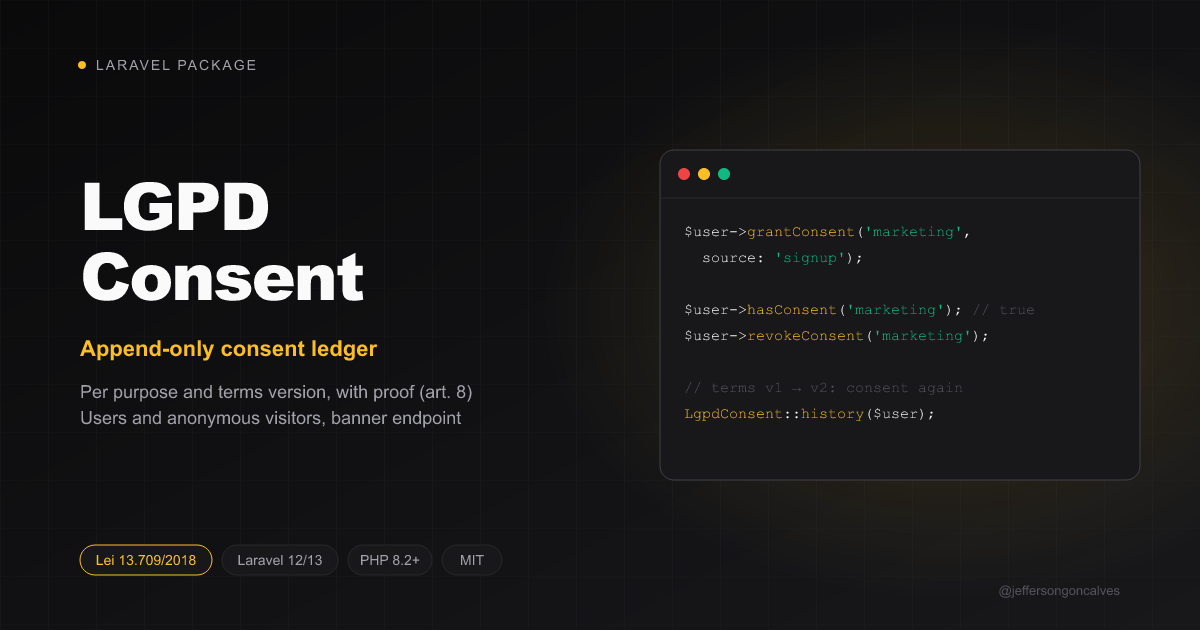



Consent ledger for the Brazilian General Data Protection Law (LGPD, Lei 13.709/2018). It is part of the laravel-lgpd suite.
Under the LGPD the controller must prove that consent was given (art. 8, §2), and consent can be revoked at any time (art. 8, §5). This package records every decision as a new row, and never updates or deletes a row:
- grants and revocations per purpose, with the terms version in force at the time;
- proof of consent: IP address, user agent, source, and custom metadata;
- when you bump a purpose's terms version, consents given under the old version stop counting;
- consents can expire after a period you configure;
- works for users (any Eloquent model) and for anonymous visitors (a random id stored in a cookie);
- an optional endpoint where your cookie banner can record each choice.
This package gives you tooling. It does not make you compliant on its own. You still need legal review for your purposes and terms.
Installation
composer require jeffersongoncalves/laravel-lgpd-consent
php artisan vendor:publish --tag="lgpd-consent-migrations"
php artisan migrate
php artisan vendor:publish --tag="lgpd-consent-config"
Configuration
// config/lgpd-consent.php
'purposes' => [
    'marketing' => ['version' => '2026-11', 'expires_after' => '1 year'],
    'analytics' => ['version' => '1'],
],
When purposes is set, unknown purposes are rejected. When it is empty, any purpose is accepted and no version is enforced.
Usage
use JeffersonGoncalves\LgpdConsent\Concerns\HasConsents;

class User extends Authenticatable
{
    use HasConsents;
}

$user->grantConsent('marketing', source: 'signup-form', metadata: ['checkbox' => 'newsletter']);
$user->hasConsent('marketing');   // true
$user->revokeConsent('marketing');
$user->consents;                  // full history
For visitors who have no account, or from anywhere else:
use JeffersonGoncalves\LgpdConsent\Facades\LgpdConsent;

LgpdConsent::grant($anonymousId, 'analytics');
LgpdConsent::has($anonymousId, 'analytics');
LgpdConsent::history($user, 'marketing');
Every decision dispatches JeffersonGoncalves\LgpdConsent\Events\ConsentRecorded.
Endpoint for banners
Enable it with route.enabled => true, then send:
fetch('/lgpd/consent', {
    method: 'POST',
    headers: { 'Content-Type': 'application/json', 'X-CSRF-TOKEN': token },
    body: JSON.stringify({ purpose: 'analytics', granted: true }),
});
A logged-in user's choice is recorded on the user. A guest's choice is recorded under a random id, which is kept in an encrypted cookie (lgpd_consent_id).
laravel-cookie-consent (4.4+) detects this endpoint on its own. From then on, its banner records every allow and deny under the purpose cookies. If you configure purposes, add cookies to that list.
Append-only
Calling update() or delete() on a ConsentRecord throws an exception. The one exception is the personal data columns (ip_address, user_agent): the records are declared with laravel-lgpd's #[PersonalData], so you can still clear those columns with $record->anonymizePersonalData().
Testing
composer test
Changelog
See CHANGELOG.
License
The MIT License (MIT). See License File.